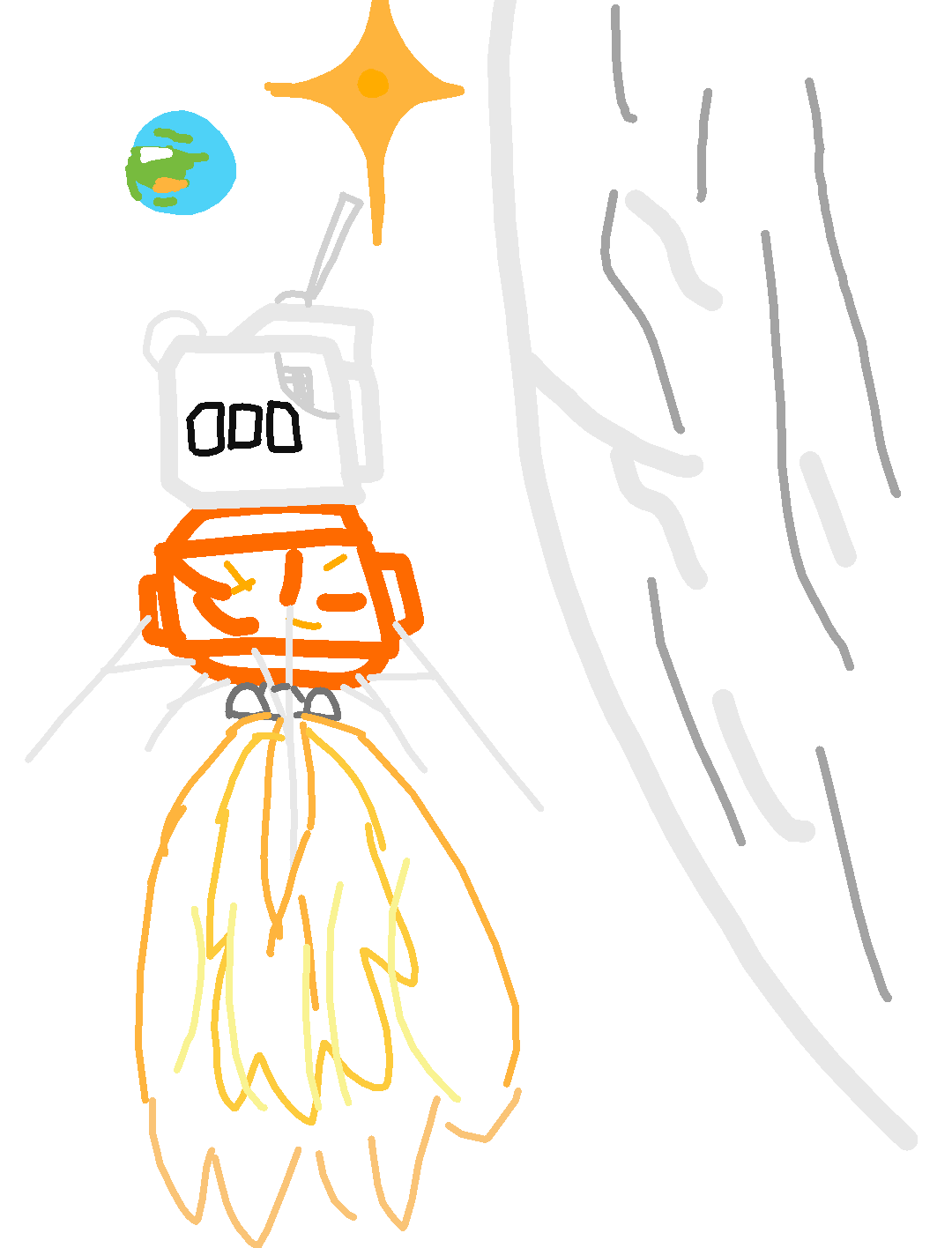
The 1st man landed in the moon [Neil Armstrong, Buzz Aldrin]
Eagle[Lunar Lander/Apollo 11 Story:]
Apollo 11 was the spaceflight that first landed humans on the Moon. Commander Neil Armstrong and lunar module pilot Buzz Aldrin formed the American crew that landed the Apollo Lunar Module Eagle on July 20, 1969, at 20:17 UTC (14:17 CST). Armstrong became the first person to step onto the lunar surface six hours and 39 minutes later on July 21 at 02:56 UTC; Aldrin joined him 19 minutes later. They spent about two and a quarter hours together outside the spacecraft, and they collected 47.5 pounds (21.5 kg) of lunar material to bring back to Earth. Command module pilot Michael Collins flew the Command Module Columbia alone in lunar orbit while they were on the Moon's surface. Armstrong and Aldrin spent 21 hours, 36 minutes on the lunar surface at a site they named Tranquility Base before lifting off to rejoin Columbia in lunar orbit.
The story of Neil Armstrong:A graduate of Purdue University, Armstrong studied aeronautical engineering; his college tuition was paid for by the U.S. Navy under the Holloway Plan. He became a midshipman in 1949 and a naval aviator the following year. He saw action in the Korean War, flying the Grumman F9F Panther from the aircraft carrier USS Essex. In September 1951, while making a low bombing run, Armstrong's aircraft was damaged when it collided with an anti-aircraft cable, strung across a valley, which cut off a large portion of one wing. Armstrong was forced to bail out. After the war, he completed his bachelor's degree at Purdue and became a test pilot at the National Advisory Committee for Aeronautics (NACA) High-Speed Flight Station at Edwards Air Force Base in California. He was the project pilot on Century Series fighters and flew the North American X-15 seven times. He was also a participant in the U.S. Air Force's Man in Space Soonest and X-20 Dyna-Soar human spaceflight programs.
Armstrong joined the NASA Astronaut Corps in the second group, which was selected in 1962. He made his first spaceflight as command pilot of Gemini 8 in March 1966, becoming NASA's first civilian astronaut to fly in space. During this mission with pilot David Scott, he performed the first docking of two spacecraft; the mission was aborted after Armstrong used some of his re-entry control fuel to stabilize a dangerous roll caused by a stuck thruster. During training for Armstrong's second and last spaceflight as commander of Apollo 11, he had to eject from the Lunar Landing Research Vehicle moments before a crash.
On July 20, 1969, Armstrong and Apollo 11 Lunar Module (LM) pilot Buzz Aldrin became the first people to land on the Moon, and the next day they spent two and a half hours outside the Lunar Module Eagle spacecraft while Michael Collins remained in lunar orbit in the Apollo Command Module Columbia. When Armstrong stepped onto the lunar surface, he famously said: "That's one small step for [a] man, one giant leap for mankind." Along with Collins and Aldrin, Armstrong was awarded the Presidential Medal of Freedom by President Richard Nixon. President Jimmy Carter presented Armstrong with the Congressional Space Medal of Honor in 1978, and Armstrong and his former crewmates received a Congressional Gold Medal in 2009.
After he resigned from NASA in 1971, Armstrong taught in the Department of Aerospace Engineering at the University of Cincinnati until 1979. He served on the Apollo 13 accident investigation and on the Rogers Commission, which investigated the Space Shuttle Challenger disaster. He acted as a spokesman for several businesses and appeared in advertising for the automotive brand Chrysler starting in January 1979.
The story of Buzz Aldrin:Born in Glen Ridge, New Jersey, Aldrin graduated third in the class of 1951 from the United States Military Academy at West Point, with a degree in mechanical engineering. He was commissioned into the United States Air Force, and served as a jet fighter pilot during the Korean War. He flew 66 combat missions and shot down two MiG-15 aircraft.
After earning a Sc.D. degree in astronautics from the Massachusetts Institute of Technology, Aldrin was selected as a member of NASA's Astronaut Group 3, making him the first astronaut with a doctoral degree. His doctoral thesis was Line-of-Sight Guidance Techniques for Manned Orbital Rendezvous, earning him the nickname "Dr. Rendezvous" from fellow astronauts. His first space flight was in 1966 on Gemini 12 during which he spent over five hours on extravehicular activity. Three years later, Aldrin set foot on the Moon at 03:15:16 on July 21, 1969 (UTC), nineteen minutes after Armstrong first touched the surface, while command module pilot Michael Collins remained in lunar orbit. A Presbyterian elder, Aldrin became the first person to hold a religious ceremony on the Moon when he privately took communion.
Upon leaving NASA in 1971, Aldrin became Commandant of the U.S. Air Force Test Pilot School. He retired from the Air Force in 1972, after 21 years of service. His autobiographies Return to Earth (1973), and Magnificent Desolation (2009), recount his struggles with clinical depression and alcoholism in the years after leaving NASA. He continued to advocate for space exploration, particularly a human mission to Mars, and developed the Aldrin cycler, a special spacecraft trajectory that makes travel to Mars more efficient in regard to time and propellant. He has been accorded numerous honors, including the Presidential Medal of Freedom in 1969.
Sorcues: Oversimplified, Wikipeidea
4 years ago 19 views 1 frames
Get App
Draw your original anime with iOS/Android App!
